Sunday, 8 September 2013

South African town accused of keeping apartheid alive

South African town accused of keeping apartheid alive

By Nkepile Mabuse, CNN
May 31, 2013 -- Updated 1043 GMT (1843 HKT)
Whites-only area reminiscent of apartheid

STORY HIGHLIGHTS
  • The South African community of Kleinfontein is accused of keeping apartheid's ideals alive
  • Apartheid was a policy of systematic racial discrimination
  • A Kleinfontein spokeswoman says it is a "cultural community" for Afrikaaners only
  • Its residents are accused of using culture and heritage to discriminate against black people
(CNN) -- More than two decades after the death of the systematic racial discrimination policy of apartheid, a community living southeast of South Africa's capital Pretoria is being accused of trying to keep its racist ideals alive.
White men clad in military uniforms stamped with an old South African flag guard the gates of the controversial settlement known as Kleinfontein.
All the signs within its boundaries are written in Afrikaans, the language that developed out of the Dutch dialect spoken by early colonizers and which is spoken by the town's 1,000 white inhabitants.
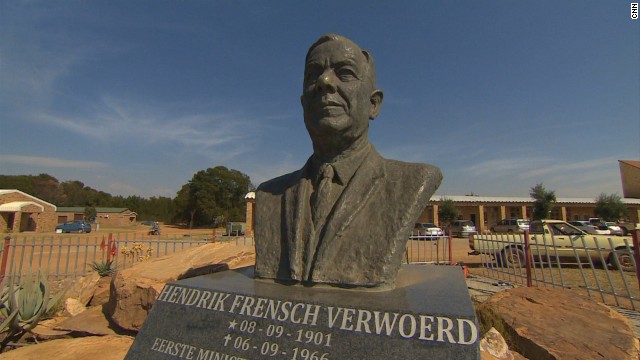
A bust of Hendrick Verwoerd, the assassinated prime minister considered the architect of apartheid, greets visitors upon entry.
"Kleinfontein is a cultural community," explains its spokeswoman Marisa Haasbroek, "if you are not an Afrikaaner you cannot live here." Afrikaaners are white South Africans of mostly Dutch descent. The private settlement has made headlines in recent weeks after it was exposed by a local newspaper. Haasbroek defends its existence saying residents simply want to live among their own kind.
The 50-year-old mother of two tells CNN she moved to Kleinfontein six years ago shortly after her car was stolen in the city center.
"I was just sick of crime," she says. "My parents-in-law were already living here and they told us Kleinfontein is safe," Haasbroek, her engineer husband and their children packed their belongings and moved to the "whites only" enclave.
The area has been in existence since the 1990s. It was formed on the eve of democratic elections at around the same time as its better-known sister settlement, Orania, in the Northern Cape. Most South Africans knew Orania but have only recently learned about Kleinfontein.
Its residents are accused of using culture and heritage to discriminate against black people.
There were even reports that the community has once refused to be assisted by black police officers.
"That's simply not true," Haasbroek says. "We do not discriminate, we differentiate."
South Africa's official opposition recently held a protest at Kleinfontein vowing to "liberate" residents from their "apartheid mindsets."
The mayor of Tshwane -- the municipality Kleinfontein falls under -- has also conducted a site visit, saying he supported the residents' right to "conserve their heritage but that it must be balanced with the freedom of others to reside anywhere in the republic."
Despite differing opinions on the matter their right to self-determination is protected by the constitution and the government has said they have the right to live this way.
Race is still an emotional topic in South Africa and Haasbroek has been at pains to explain that residents are screened based on culture, language, religion, history - but not race.
"We are trying to preserve our own identity," Haasbroek says. "We are swamped by people who are not like us. We are a minority like the people of Tibet in China and like the Palestinians. But we don't want our own state. We respect the laws of South African and we want to remain here."
Orania and Kleinfontein represent about 2,000 people, a tiny minority of the overall Afrikaaner community in South Africa. Haasbroek says crime and affirmative action have left them feeling left out of the so-called "Rainbow Nation."
"We don't really feel welcomed in the new South Africa so we are saying, just give us a little bit of independence."
They already run their own school and they build their own infrastructure. They want to be recognized as a self-contained municipality -- something the local government has said will not happen.

http://edition.cnn.com/2013/05/31/world/africa/south-africa-kleinfontein-apartheid-nkepile-mabuse

Monday, 15 July 2013

Un' altro 'cattivo'

Si toglie le infradito e rincorre scippatore. Un migrante eroe sul Viale della Stazione
Restituita la borsa alla vecchietta scippata

Quando ha visto che la vecchietta era stata scippata della sua borsa, non ci ha pensato un momento. Si è sfilato le infradito dai piedi e si è messo alla caccia del ladro. Lo ha rincorso lungo il viale della Stazione, scansando panchine e passanti. Una volta raggiunto il ladruncolo, ha recuperato la borsa e  permesso alle forze dell'ordine di arrestare il malvivente. Protagonista di questo episodio che mette in risalto un grande senso civico, un giovane ragazzo africano, che trovandosi a passare lungo il Viale della Stazione di Foggia ha notato tutta la scena.

AL POSTO GIUSTO Coraggio e velocità, poi, hanno fatto il resto e così il migrante ha potuto restituire borsa e refurtiva alla legittima proprietaria. Un evento di cronaca nera finito a lieto fine e capitato proprio nella strada in cui negli ultimi anni non sempre sono facili i rapporti di convivenza tra commercianti e residenti italiani, ed immigrati. Ma questa volta, la fortuna ha voluto che quel ragazzo si trovasse a passare al posto giusto nel momento giusto.

Grazie per la foto a S.D.

http://www.foggiacittaaperta.it/news/si-toglie-le-infradito-e-rincorre-scippatore-un-migrante-eroe-sul-viale-della-stazione.asp

CALDEROLI & CO...Insulti...Insulti e insulti !!!!!!!

Calderoli: "Kyenge? Sembra un orango"
Letta: "Inaccettabile". Colle indignato

Fonti Quirinale: "Napolitano colpito da gravi episodi". Condanna del premier Consiglio. Il vicepresidente del Senato del Carroccio: "Solo una battuta simpatica, ho telefonato per scusarmi". Il ministro dell'Integrazione: "Provo rammarico, l'offesa è per l'Italia". Maroni: "Ha sbagliato, ma ha chiesto scusa". Salvini: "Parole fuori posto, ma lei è pericolosa". Speroni (Lega): "È paffutella,  sembra l'omino Michelin"
ROMA - È polemica sulle dichiarazioni shock del leghista Roberto Calderoli che, alla festa del suo partito a Treviglio, ha detto riferendosi al ministro Cecile Kyenge: "Quando la vedo non posso non pensare a un orango". Parole infelici che non sono piaciute nemmeno agli altri esponenti del Carroccio e hanno scatenato una bufera: Letta è furioso, il Pd chiede le dimissioni del senatore da vicepresidente del Senato, lui si giustifica riducendo l'accaduto a una "battuta simpatica" e il ministro dell'Integrazione, vittima dell'attacco, esprime rammarico: "Le parole di Calderoli non le prendo come un'offesa personale, ma mi rattristano per l'immagine che diamo dell'Italia. Credo che tutte le forze politiche debbano riflettere sull'uso che fanno della comunicazione". E Maroni interviene solo in serata: "Ha sbagliato, ma si è scusato".

Telefonata di scuse. In serata il ministro Calderoli ha detto di essersi scusato personalmente con Kyenge: ''Ho parlato poco fa al telefono col ministro Kyenge e mi sono scusato. Ci siamo chiariti - ha aggiunto l'esponente leghista - e ci siamo dati appuntamento in Parlamento per un confronto franco e leale''. Poco dopo ha parlato anche il ministro: "Sì, il sen. Calderoli mi ha telefonato ed io ho accettato le scuse. Ma il nodo istituzionale resta: ciascuno deve tener presente sempre la carica che riveste". Caso chiuso? "Il caso non è mai esistito a livello personale - ha risposto Kyenge -, resta aperto a livello istituzionale". 

Colle indignato. Ma una telefonata forse non basterà a spegnere le polemiche e fonti del Quirinale hanno fattoo sapere che anche il presidente della Repubblica, Giorgio Napolitano, è "colpito ed indignato" per alcuni "gravi episodi" accaduti in questi questi giorni, dalla vicenda delle minacce a Mara Carfagnaall'incendio del liceo Socrate di Roma, fino agli insulti odierni al ministro Kyenge,  "che dimostrano tendenza all'imbarbarimento delle vita civile e affronterà il tema nell'incontro con la stampa del 18 luglio".

Letta furioso. A condannare senza appello la frase razzista è il presidente del Consiglio Enrico Letta: "Inaccettabili oltre ogni limite le parole di Calderoli - scrive il premier su Twitter - avanti Cecile col tuo lavoro! Siamo con te". 

Le giustificazioni di Calderoli.
 Per tutto il giorno Calderoli si difende: "È stata solo una battuta simpatica", spiega in un'intervista a Radio Capital. "Ho parlato in un comizio - tenta di giustificarsi - la mia battuta si è inserita in un ben più articolato e politico intervento di critica al ministro e alla sua politica". Ma persiste nella linea xenofoba: "Avevo appena detto che sarebbe un'ottima ministra... in Congo. Va benissimo come ministro ma a casa propria". Quanto all'ipotesi di dimissioni taglia corto: "Stiamo scherzando? Non ci penso proprio". In serata ha aggiunto al Tg1: ''Sono disponibile al confronto, ma sono pronto a dare battaglia in tutte le sedi riguardo alle sue posizioni che considero sbagliate sull'immigrazione''.
http://www.repubblica.it/politica/2013/07/14/news/vedo_il_ministro_kyenge_e_penso_a_un_orango_e_polemica_per_la_frase_del_leghista_calderoli-62945682/?ref=fbpr

Tuesday, 25 June 2013

Samia urges Italy to invest more in Africa

Samia urges Italy to invest more in Africa

on .


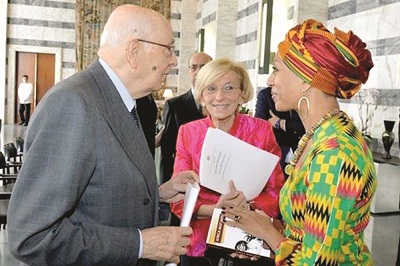
The Chairperson of the Convention People’s Party, Ms Samia Nkrumah, has called on Italy to have the courage to invest more in Africa. Samia Nkurmah interacting with Mr Giorgio Napolitano, President of the Republic of Italy,  and Hon. Emma Bonino, Italian Minister of Foreign Affairs.Samia Nkurmah interacting with Mr Giorgio Napolitano, President of the Republic of Italy, and Hon. Emma Bonino, Italian Minister of Foreign Affairs.
As we speak, there is no Italian bank in sub-Saharan Africa with a strategy of opening up to markets of Africa, she told a gathering in Rome, the Italian capital. The occasion was to mark the city of Rome’s version of African Union Day. Under the theme,  OAU/AU @50 in Rome, it was attended by Mr Giorgio Napolitano, President of the Republic of Italy;  Hon. Emma Bonino, Italian Minister of Foreign Affairs; the African Diplomatic Corps in Italy and ministers of state including Hon. Cecile Kyenge, Minister of Integration and first minister in Italy of African origin.
According to Ms Nkrumah, “In Ghana, for example, in the last three years, the economy grew by an average of eight per cent. The USA, UK, China and Turkey have doubled their investments in Ghana.
I have no doubt it is the same for many other African countries. I am using this occasion to urge Italian Industrialists and bankers to be courageous and innovative.Show the same courage of your visionary industrialist, Enrico Mattei, who in the 60s helped us build our infrastructure and gave opportunities to so many ordinary men and women who started a new history of development, co-operation and self-reliance. We want to see in Africa many more men and women such as Enrico Mattei”.
These were contained in a statement issued in Accra yesterday and signed by Nii Armah Akomfrah, CPP Director of Communication.
According to the statement, Samia Yaba Nkrumah was in Addis Ababa to mark the historic 50th Anniversary of the OAU/AU, then moved on to Italy where the city of Rome also marked the anniversary with its own event.
The CPP chair and leader, in her address, expressed deep gratitude and thanked President Napolitano for his visit to Ghana in 2007, his first official trip a few weeks after his election as President.
She also thanked Foreign Minister Emma Bonino who she called an activist and an Italian Rosa Parks.
“For years, Emma has sought to make the West and Africans alike understand that there is no Africa tomorrow without human rights for her women today,” she said.
She reminded her audience that 50 years ago, independent African countries came together to consolidate their newly won freedom by committing themselves to think together, work together and organise African economies as one unit.
The CPP leader noted that “Our colonisation came with our division, so it is only logical that our freedom comes with our unification”.
Ms Nkrumah told the gathering that the journey towards continental integration had not been smooth, saying “That there have been some achievements along the way such as de-colonisation and ending settler regimes and apartheid, but that there has also been some rough patches as well.”
She said  “We hesitated between regionalism and continental planning. We argued over the fast-track or gradualist approach to integration: A United States of Africa including political and continental planning as a necessary basis for economic and social integration, or economic associations anchored on a gradualist approach to integration”
She added that notwithstanding the setbacks, Africa had managed to generate some excellent proposals – “the 1980 Lagos Plan of Action, with its vision of an integrated African Market by 2000 (sadly we never got there), the Abuja Treaty which envisaged an African Economic Community by 2028 (too far away) and the establishment of an African Economic and Monetary Union by 2023 to 2028 and the New Partnership for Africa’s Development. We have also recognised the African Diaspora as the sixth region of the continent but we are hoping to make this relationship legally binding by a constitutive act. We want to see every single African outside the continent as part of the economic and social transformation of our continent”.
The CPP chair went on to say that “notwithstanding the rebranding of our continental body in 2002 into the African Union (AU) of today, if we want to be honest with ourselves, we will have to admit that efforts at regional integration have not yet borne satisfactory results”.
“Today, I am revisiting our original vision for African Unity, that vision of an integrated continental planning that transcends the limitations of tinkering "with inter-territorial associations within customs union, trade agreements, inter-communications services and the like", quoting her father thus -  "for such tinkering does not create the decisive conditions for resolute development, since it ignores the crucial requirement of continental integration as the essential prerequisite for the most bountiful economic progress, which must be based in the widest possible extension of land and population".
Samia Nkrumah continued by saying “Imagine an Africa in which our leaders are prepared to seriously consider ceding some powers to a supra-national body showing real commitment to the development, well-being and prosperity of our citizens.
Imagine an Africa, confident and assertive; a continent free from food insecurity, rather than one that imports one-third of its grain. We want an Africa that is making use of the economies of scale, with bigger markets more attractive to investors both local and international;  a continent whose people have high purchasing power to strengthen local economies and absorb the manufactured goods of other continents. Developed countries should have a vested interest in Africa's prosperity and the well-being of Africa because only with bigger markets and wealthier people can Africa absorb your goods. Only then will our continent bring opportunities for Europe in times of crisis.
“Once the average citizen of Africa can enjoy the freedom that comes with prosperity such as access to quality education, basic healthcare, potable water, adequate sanitation, confidence in our rich cultural heritage, then we will be able to strengthen our institutions such as Parliament, anti-corruption institutions and the like that deal with governance, citizens’ rights and public welfare. We will be better to fight corruption and consolidate our democracy and realise social transformation.
“Our prosperity is in unity and control of our resources for the benefit of our citizens. We do not want the billions we receive from the West through aid to be wasted through weak institutions but we want them to benefit the millions of young Africans who want, and have every right to achieve something of significance.
“I can assure you that the average African, who is by the way a young person, is suffering from this unequal relationship with other continents. The average African pays the price when we produce only basic raw materials. In the 60s, a ton of cocoa could purchase a small car. Today you need at least 10 tons of cocoa to get the same car. We must add value to what we produce so we can earn more and translate that greater revenue into the well-being for our citizens”.
http://graphic.com.gh/Politics/samia-urges-italy-to-invest-more-in-africa.html
news

Friday, 18 January 2013

Le possibili conseguenze in occidente del conflitto in Mali

Le possibili conseguenze in occidente del conflitto in Mali

14 gennaio 2013

Reuters_Joe Penney
Lo scorso venerdì, dopo quasi 9 mesi di relativa “pace interna”, il gruppo di ribelli islamici Ansar al-Din ha occupato la città di Konna, 55 km a nord di Mopti, dichiarando ufficialmente di voler estendere il proprio controllo sul nord del paese.

Immediate le reazioni interne ed internazionali.
Nella giornata dell’11 gennaio, i ministri maliani si sono riuniti nella capitale per discutere un piano d’azione per recuperare il controllo del nord. Le Nazioni Unite hanno comunicato l’intenzione di voler inviare un contingente di 3.000 persone a protezione della popolazione civile interna. Il presidente francese Hollande ha prontamente confermato la vicinanza del paese al Mali, promettendo un immediato intervento sotto l’egida del Consiglio di Sicurezza del Nord.

Già nella giornata di sabato 12 gennaio, i caccia aerei francesi hanno bombardato alcune postazioni dei ribelli nelle città del nord, riuscendo a riconquistare, secondo quanto confermato dal Ministro degli Esteri francese, Laurent Fabius, la città di Konna. Nella giornata di domenica, Fabius ha affermato che la Francia, beneficia dell’appoggio di varie nazioni europee: "Abbiamo il sostegno, anche pratico, della Gran Bretagna, dei nostri amici danesi, e di molti altri grandi Paesi che forniscono aiuti nel settore dei trasporti".

L’intervento militare francese si rifà a una richiesta di aiuti di Bamako, legittimata dall’articolo 51 della Carta delle Nazioni Unite che prevede un diritto di difesa, individuale o collettivo, nel caso in cui un paese membro sia oggetto di un’aggressione armata. Il Ministro degli Esteri francese ha sottolineato che il suo intervento non andrà oltre alcune settimane, essendo finalizzato esclusivamente ad arrestare l’avanzata dei ribelli.

Ancora confusi i dati sul numero di vittime: un ufficiale dell’esercito maliano già sabato parlava di oltre 100 miliziani islamici uccisi, mentre Human Rights Watch riporta 10 decessi tra i civili nella città di Konna. Fonti ufficiali dichiarano inoltre che dall’inizio dell’attacco sono caduti 11 militari dell’esercito regolare maliano e 1 pilota d’elicottero francese.

E' importante però sottolineare che il conflitto in Mali ha caratteristiche differenti dagli altri scenari di guerra in Africa, che hanno conseguenze marginali per l'occidente. I gruppi islamici maliani hanno forti collegamenti con Boko Haram, il gruppo militante nigeriano che fece saltare in aria l'ufficio delle Nazioni Unite ad Abuja nel 2011 e con Ansar al- Sharia, responsabile dell'assasinio dell'ambasciatore Christopher Stevens e altri 3 americani a Benghazi in Libia, lo scorso settembre.
Già nella giornata di ieri sono scattate le prime minacce di ritorsione verso gli interventi francesi nel paese.

Vi proponiamo qui l'importante intervista di Intersos a Code Cisse, responsabile della missione in Mali dell'organizzazione.
Foto: Reuters_Joe Penney
 http://agire.it/it/mediaroom_agire/news_agire_onlus/newsDetail.html?DETTAGLIO=ff8080813b2d6946013c38d433800031&gclid=COKHqe_P8LQCFc2R3godbywAcw