Showing posts with label VIOLENCE. Show all posts

Wednesday, 28 September 2011

THE DESTRUCTION OF SIRTE.......


HUNTING FOR GHEDDAFI:


THE DESTRUCTION IF SIRTE (Libya) AND ITS INHABITANTS VERY LEGITMATE?

Sunday, 22 May 2011

Aircraft carrier left us to die, say migrants

Aircraft carrier left us to die, say migrants


Exclusive: Boat trying to reach Lampedusa was left to drift in Mediterranean for 16 days, despite alarm being raised


* Jack Shenker in Lampedusa * guardian.co.uk, Sunday 8 May 2011 21.30 BST

Refugees from Libya reach Lampedusa
Refugees from Libya reach Lampedusa. A warship failed to rescue a boat in trouble – leaving 61 people on board to die. Photograph: Francesco Malavolta/EPA

Dozens of African migrants were left to die in the Mediterranean after a number of European military units apparently ignored their cries for help, the Guardian has learned. Two of the nine survivors claim this included a Nato ship.

A boat carrying 72 passengers, including several women, young children and political refugees, ran into trouble in late March after leaving Tripoli for the Italian island of Lampedusa. Despite alarms being raised with the Italian coastguard and the boat making contact with a military helicopter and a warship, no rescue effort was attempted.

All but 11 of those on board died from thirst and hunger after their vessel was left to drift in open waters for 16 days. "Every morning we would wake up and find more bodies, which we would leave for 24 hours and then throw overboard," said Abu Kurke, one of only nine survivors. "By the final days, we didn't know ourselves … everyone was either praying, or dying."

International maritime law compels all vessels, including military units, to answer distress calls from nearby boats and to offer help where possible. Refugee rights campaigners have demanded an investigation into the deaths, while the UNHCR, the UN's refugee agency, has called for stricter co-operation among commercial and military vessels in the Mediterranean in an effort to save human lives.

"The Mediterranean cannot become the wild west," said spokeswoman Laura Boldrini. "Those who do not rescue people at sea cannot remain unpunished."

Her words were echoed by Father Moses Zerai, an Eritrean priest in Rome who runs the refugee rights organisation Habeshia, and who was one of the last people to be in communication with the migrant boat before the battery in its satellite phone ran out.
"There was an abdication of responsibility which led to the deaths of over 60 people, including children," he claimed. "That constitutes a crime, and that crime cannot go unpunished just because the victims were African migrants and not tourists on a cruise liner."

This year's political turmoil and military conflict in north Africa have fuelled a sharp rise in the number of people attempting to reach Europe by sea, with up to 30,000 migrants believed to have made the journey across the Mediterranean over the past four months. Large numbers have died en route; last month more than 800 migrants of different nationalities who left on boats from Libya never made it to European shores and are presumed dead.

Underlining the dangers, on Sunday more than 400 migrants were involved in a dramatic rescue when their boat hit rocks on Lampedusa.

The pope, meanwhile, in an address to more than 300,000 worshippers, called on Italians to welcome immigrants fleeing to their shores.

The Guardian's investigation into the case of the boat of 72 migrants which set sail from Tripoli on 25 March established that it carried 47 Ethiopians, seven Nigerians, seven Eritreans, six Ghanaians and five Sudanese migrants. Twenty were women and two were small children, one of whom was just one year old. The boat's Ghanaian captain was aiming for the Italian island of Lampedusa, 180 miles north-west of the Libyan capital, but after 18 hours at sea the small vessel began running into trouble and losing fuel.

Using witness testimony from survivors and other individuals who were in contact with the passengers during its doomed voyage, the Guardian has pieced together what happened next. The account paints a harrowing picture of a group of desperate migrants condemned to death by a combination of bad luck, bureaucracy and the apparent indifference of European military forces who had the opportunity to attempt a rescue.

The migrants used the boat's satellite phone to call Zerai in Rome, who in turn contacted the Italian coastguard. The boat's location was narrowed down to about 60 miles off Tripoli, and coastguard officials assured Zerai that the alarm had been raised and all relevant authorities had been alerted to the situation.

Soon a military helicopter marked with the word "army" appeared above the boat. The pilots, who were wearing military uniforms, lowered bottles of water and packets of biscuits and gestured to passengers that they should hold their position until a rescue boat came to help. The helicopter flew off, but no rescue boat arrived.
No country has yet admitted sending the helicopter that made contact with the migrants. A spokesman for the Italian coastguard said: "We advised Malta that the vessel was heading towards their search and rescue zone, and we issued an alert telling vessels to look out for the boat, obliging them to attempt a rescue." The Maltese authorities denied they had had any involvement with the boat.
After several hours of waiting, it became apparent to those on board that help was not on the way. The vessel had only 20 litres of fuel left, but the captain told passengers that Lampedusa was close enough for him to make it there unaided. It was a fatal mistake. By 27 March, the boat had lost its way, run out of fuel and was drifting with the currents.

"We'd finished the oil, we'd finished the food and water, we'd finished everything," said Kurke, a 24-year-old migrant who was fleeing ethnic conflict in his homeland, the Oromia region of Ethiopia. "We were drifting in the sea, and the weather was very dangerous." At some point on 29 or 30 March the boat was carried near to an aircraft carrier – so close that it would have been impossible to be missed. According to survivors, two jets took off from the ship and flew low over the boat while the migrants stood on deck holding the two starving babies aloft. But from that point on, no help was forthcoming. Unable to manoeuvre any closer to the aircraft carrier, the migrants' boat drifted away. Shorn of supplies, fuel or means of contacting the outside world, they began succumbing one by one to thirst and starvation.

The Guardian has made extensive inquiries to ascertain the identity of the aircraft carrier, and has concluded that it is likely to have been the French ship Charles de Gaulle, which was operating in the Mediterranean on those dates.

French naval authorities initially denied the carrier was in the region at that time. After being shown news reports which indicated this was untrue, a spokesperson declined to comment.

A spokesman for Nato, which is co-ordinating military action in Libya, said it had not logged any distress signals from the boat and had no records of the incident. "Nato units are fully aware of their responsibilities with regard to the international maritime law regarding safety of life at sea," said an official. "Nato ships will answer all distress calls at sea and always provide help when necessary. Saving lives is a priority for any Nato ships."

For most of the migrants, the failure of the ship to mount any rescue attempt proved fatal. Over the next 10 days, almost everyone on board died. "We saved one bottle of water from the helicopter for the two babies, and kept feeding them even after their parents had passed," said Kurke, who survived by drinking his own urine and eating two tubes of toothpaste. "But after two days, the babies passed too, because they were so small."

On 10 April, the boat washed up on a beach near the Libyan town of Zlitan near Misrata. Of the 72 migrants who had embarked at Tripoli, only 11 were still alive, and one of those died almost immediately on reaching land. Another survivor died shortly afterwards in prison, after Gaddafi's forces arrested the migrants and detained them for four days.

Lampedusa The route of the boat

Despite the trauma of their last attempt, the migrants – who are hiding out in the house of an Ethiopian in the Libyan capital – are willing to tackle the Mediterranean again if it means reaching Europe and gaining asylum.

"These are people living an unimaginable existence, fleeing political, religious and ethnic persecution," said Zerai. "We must have justice for them, for those that died alongside them, and for the families who have lost their loved ones."

Additional reporting by John Hooper and Tom Kington in Rome, and Kim Willsher in Paris

• This article was amended on 9 May 2011. The original version referred throughout to a Nato ship. This has been changed to European units pending further clarification. The picture caption also used the wrong figure for the death toll. This has been corrected.

Saturday, 23 April 2011

"...LIKE A DEATH SENTANCE ON GHADEFFI..."

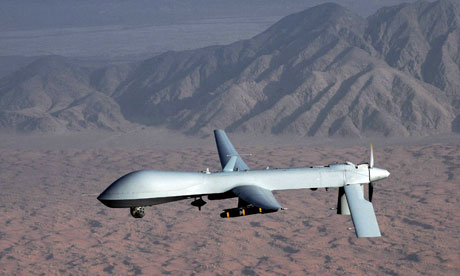
Drones can be used by Nato forces in Libya, says Obama

Senior Nato military commanders have been pressing for the unmanned US planes to strike Gaddafi forces in besieged Misrata
  • Predator drone aircraft
    Precision targeting provided by unmanned drones has become a favoured strike weapon in Afghanistan, and could help Nato pinpoint Gaddafi forces in Libya. Photograph: Sipa Press/Rex Features
    The White House has approved the use of missile-armed Predator drones to help Nato target Colonel Gaddafi's forces in Libya. Coalition commanders have been privately urging the Americans to provide the specialist unmanned aircraft, which have become a favoured – if controversial – weapon in Afghanistan and Pakistan. Their ability to hone in on targets using powerful night-vision cameras is considered to be one way of helping rebels in the besieged city of Misrata, where a humanitarian crisis has unfolded in the last week. The US defence secretary, Robert Gates, said Barack Obama had approved the use of the Predators which are armed with Hellfire missiles, signalling a marked growth in the US contribution to the Nato effort. Gates told a Pentagon news conference that the Predator was an example of the unique US military capabilities that the president is willing to contribute while other countries enforce a no-fly zone. General James Cartwright said that the first Predator mission in Libya had been scheduled for Thursday night but was abandoned because of poor weather. The US military plans to maintain two patrols of armed Predators above Libya at any given time, permitting better surveillance – and targeting – of Gaddafi's forces as they dig into positions next to civilian areas, Cartwright told the same briefing. The drones are based in the region but typically flown via remote control by pilots in the US. The drones for Libya had not been withdrawn from Afghanistan, Gates and Cartwright said. Khaled Kayim, Libya's deputy foreign minister, said the deployment of the drones would result in the deaths of more civilians. He described the move as "undemocratic and illegitimate and I hope they will reverse their decision". Liam Fox, the British defence secretary, and Sir David Richards, the chief of the defence staff, are due in Washington next week to discuss the situation in Libya. The use of Predators is one of the topics to be discussed at the Pentagon talks next Tuesday, as well as other specialist equipment that might be provided by the US. David Cameron has again insisted that Nato had no intention of deploying ground troops, but that did not mollify Russia. It condemned the sending of military advisers to Libya by the UK and France, saying it exceeded the mandate of UN security council resolution 1973. "We are not happy about the latest events in Libya, which are pulling the international community into a conflict on the ground," said the Russian foreign minister, Sergei Lavrov."This may have unpredictable consequences," he added. But senior Whitehall officials believe the use of drones, also known as UAVs, would not be beyond the remit, or the spirit, of the UN resolution which gave the coalition a mandate to protect civilians. "A UAV with sufficiently high-resolution sensors, were it armed, could fire that weapon in line of sight and still meet the tight rules of engagement," a Whitehall source said. "We have been asking if we can get the US to provide that capability for us. It exists – the question is can we get it to be deployed? UAVs would give you speed of response where you see the regime transgressing the UN resolution," the source said. The US is understood to have the UAVs in the region already. Gates said Obama continues to be opposed to sending US ground forces into Libya and there were no plans to send US trainers to augment Nato forces already working with rebel forces. "There's no wiggle room in that," Gates said. The UN secretary general, Ban Ki-Moon, urged Gaddafi to "stop killing people", and estimated that 500,000 Libyans had fled the country. The MoD also sought to counter criticism Nato is not doing enough for Misrata, saying the RAF had hit 58 targets around the city in the past three weeks, including 37 main battle tanks. But officials concede the difficulties of targeting within the city are considerable. Earlier this week Nato's commander, Lt Gen Charles Bouchard, described the situation within Misrata as being akin to "a knife fight in a phone booth". He said Gaddafi forces were hiding on the rooftops of mosques, hospitals and schools, and that they were shielding themselves behind women and children. The military difficulties were underlined when further details emerged of the death of British photographer Tim Hetherington, who was killed on Wednesday in a mortar attack along with a colleague, Chris Hondras. An Oscar-nominated filmmaker, Hetherington, 41, wrote in his last Twitter post on Tuesday: "In besieged Libyan city of Misrata. Indiscriminate shelling by Gaddafi forces. No sign of Nato." Vanity Fair editor Graydon Carter said Hetherington was "about as perfect a model of a war photographer as you're going to find these days". http://www.guardian.co.uk/world/2011/apr/21/nato-wants-drones-target-misrata
     

Thursday, 14 April 2011

COSTA D'AVORIO: PREMIER KENYA, AMNISTIA PER GBAGBO

Wednesday, 6 April 2011

FRANCE ..."THE NEW LOVE FOR AFRICA"


FRANCE arming and fighting alongside Oattara group in Ivory Coast..... Is this really LOVE?

Wednesday, 30 March 2011

Libya: Italian official says arming rebels could 'divide' international community


last update: March 30, 11:57 Rome, 30 March (AKI)


- Arming rebels in Libya would be a bad idea that can potentially cause divisions among the international community, according to an Italian government official.

“Arming the rebels would be a controversial measure, an extreme measure that could certainly divide the international community,” foreign ministry spokesman Maurizio Massari said Wednesday in a radio interview with Radioanch’io. Unite States president Barack Obama in a Tuesday interview with the NBC television network said he would consider arming the rebels. "I'm not ruling it out, but I'm also not ruling it in," Obama said. France also did not exclude the possibility of arming rebels when it joined other Nato members states on Tuesday in London to discuss Libya. Italian foreign minister Franco Frattini on Wednesday told Italy's Sky TG24 news channel that the African Union should work with the international community to encourage Libyan leader Muammar Gaddafi to resign.

Tuesday, 29 March 2011

London Conference on Libya

PM’s speech at London Conference on Libya

Prime Minister David Cameron’s opening remarks at the London Conference on Libya on Tuesday 29 March 2011.

Read the transcript


Let me welcome you all to London.

Foreign Ministers from more than 40 countries – from America to Asia – from Europe to Africa – from the United Nations to the Arab world. All here to unite with one purpose: to help the Libyan people in their hour of need.

Today is about a new beginning for Libya – a future in which the people of Libya can determine their own destiny, free from violence and oppression.

But the Libyan people cannot reach that future on their own.

They require three things of us.

First, we must reaffirm our commitment to UN Security Council Resolutions 1970 and 1973 and the broad alliance determined to implement it.

Second, we must ensure the delivery of humanitarian aid where it is needed, including to newly liberated towns.

And third, we must help the Libyan people plan for their future after the conflict is over.

These are the three goals of this London Conference.Let me take each in turn.

Reaffirming our commitment to the UNSCRs

First, UN Security Council Resolution 1973.

Just twelve days ago, following an appeal by the Arab League, the United Nations passed an historic resolution to protect the people of Libya from the murderous brutality of Qadhafi’s regime.

At the meeting Nicholas Sarkozy hosted in Paris, we made the right choice: to draw a line in the desert sand, and to halt his murderous advance by force.

Be in no doubt.

Our action saved the city of Benghazi.

It averted a massacre.

And it has given freedom a chance in Libya.

But be in no doubt about something else.

As I speak the people of Misurata are continuing to suffer murderous attacks from the regime.

I have had reports this morning that the city is under attack from both land and sea.

Qadhafi is using snipers to shoot them down and let them bleed to death in the street.

He has cut off food, water and electricity to starve them into submission.

And he is harassing humanitarian ships trying to get into the port to do what they can to relieve their suffering.

He continues to be in flagrant breach of the UN Security Council Resolution.

That is why there has been such widespread support amongst the Libyan people – and in the wider Arab world – for the military action we are taking.

It has saved lives, and it is saving lives.

As one Misurata resident put it: “These strikes give us hope”.

Today we must be clear and unequivocal: we will not take that hope away.

We will continue to implement United Nations Resolutions for as long as is necessary to protect the Libyan people from danger.

Humanitarian Aid

Second, humanitarian aid.

Just as it is essential that the international community works together to stop the slaughter, it’s vital that we get aid in to save lives. This has to happen now.

And it is happening.

Already we are seeing how the actions we have taken are helping to pave the way for humanitarian organisations to return to liberated cities.

Even in Misurata, humanitarian agencies have managed to get some supplies in.

In Benghazi, the ICRC, Islamic Relief and International Medical Corps are back in and are working hard.

In Ajdabiya, thousands of people have fled, but the hospital is reported to be functioning – though it urgently needs more nursing staff and supplies.

So supplies are getting in, but we need to redouble our efforts.

The whole international community needs to work together.

The UN’s has an absolutely critical role in ensuring that humanitarian aid gets through to those who need it, especially in the newly liberated towns.

Building a stable peace

When the fighting is over, we will need to put right the damage that Qadhafi has inflicted.

Repairing the hospitals ruined by shells…

…rebuilding the homes demolished by Qadhafi’s tank rounds…

…and restoring the mosques and minarets smashed by his barbarity.

It’s never too early to start planning co-ordinated action to support peace in Libya over the long term.

It is surely the UN, working with regional organisations and the rest of the international community, who should lead this work.

Repairing physical infrastructure…

…ensuring basic services…

…and helping Libyans restore functioning government at every level.

Planning for the future

Third, we must help the people of Libya plan now for the political future they want to build.

Our military actions can protect the people from attack; and our humanitarian actions can help the people recover. But neither are sufficient to provide the path to greater freedom.

Ultimately, the solution must be a political one – and it must be for the Libyan people themselves to determine their own destiny.

That means reinforcing the UN sanctions to exert the greatest possible pressure on the Qadhafi regime.

And it requires bringing together the widest possible coalition of political leaders…

…including civil society, local leaders and most importantly the Interim Transitional National Council…

…so that the Libyan people can speak with one voice.

Our task in the international community is to support Libya as it looks forward to a better future.

This will not be achieved in a matter of days or weeks.

The coalition of countries and organisations gathered here today must commit to seeing this task through.

I propose that today’s Conference should agree to set up a Contact Group, which will put political effort on a sustained basis into supporting the Libyan people.

We should be clear about the scale of the challenge. It will mean looking afresh at our entire engagement with Libya and the wider region – from our development programmes, to our cultural exchanges and trade arrangements.

All our efforts must support the building blocks of a democratic society.

Freedom of expression

The right to free and fair elections

The right to peaceful protest.

Respect for human rights and the rule of law.

These aren’t values that belong to any one nation.

They are universal.

They are embedded in the Vision of a Democratic Libya set out by the Interim Transitional National Council today.

And we should warmly welcome this commitment.

Conclusion

As this broad range of countries gathers here today in London, there are people suffering terribly under Qadhafi’s rule.

Our message to them is this: there are better days ahead for Libya.

Just as we continue to act to help protect the Libyan people from the brutality of Qadhafi’s regime…

…so we will support and stand by them as they seek to take control of their own destiny.

Their courage and determination will be rewarded.

A new beginning for Libya is within their grasp and we will help them seize it.

http://www.number10.gov.uk/news/speeches-and-transcripts/2011/03/pms-speech-at-london-conference-on-libya-62642

Thursday, 10 March 2011

Why black Africans are paying the price for the real or perceived use of mercenaries in Libya


Why black Africans are paying the price for the real or perceived use of mercenaries in Libya

COLIN FREEZE    From Tuesday's Globe and Mail

Rebels hold a young man at gunpoint, who they accuse of being a loyalist to Libyan leader Muammar Gaddafi, between the towns of Brega and Ras Lanuf, March 3, 2011


A cocked pistol points near the head of the black African teenager. A Libyan rebel barks questions in Arabic, waving an accusing finger as he suggests his captive is a paid pro-government mercenary. The youth’s face freezes with muted terror.
It’s an extraordinarily powerful image, one printed prominently in dozens of newspapers last week. And what makes it all the more potent are the details that the photographer could not capture in his frame.

“Honestly, he didn’t look to me as a mercenary at all,” Reuters’ Goran Tomasevic told The Globe and Mail from Ras Lanuf, the town near where he shot the photo.
The war photographer spoke of how he stumbled on the scene at a rebel checkpoint. There, angry onlookers were egging the interrogators on, claiming the youth – likely from Niger – had already “confessed” to being a foreign fighter. Yet he denied it, again and again.
Such scenes are playing out across Libya these days, as the uprising fuels friend-or-foe fears that resuscitate long-dormant tensions between mostly Arab citizens and foreign workers. “The black African, or sub-Saharan African population is, without any question, suffering repercussions and revenge attacks, for the real or perceived use of mercenaries by Gadhafi forces,” said Fred Abrahams of Human Rights Watch in New York.
The organization, which is calling on Western governments to help evacuate nationals from several African countries, says international media has given too much credence to inflated claims about Colonel Moammar Gadhafi’s reliance on foreign mercenaries. The group’s man on the ground, Peter Bouckaert, has even suggested that “lazy, irresponsible journalism” imperils lives.
Hundreds of thousands of migrant workers have flocked to Libya, mostly from neighbouring African states. Many of them are now being caught up in the heightening paranoia wrought by the conflict. They are hiding in urban centres and amassing along the borders in refugee camps. Compared to Westerners, whose governments are evacuating their citizenry at great expense, these migrants often have no help getting out.
Experts fear the Libyan conflict is evolving into a protracted civil war among various tribes. As both sides dig in, they accuse each other of recruiting foreign fighters. Col. Gadhafi claims his enemies are being spurred on by foreign “terrorists.” But many experts believe that the dictator himself is taking advantage of alliances he has forged over the past 40 years, with a variety of rebel forces in nearby countries.
“They certainly are non-nationals fighting for power, if you define that as a mercenary. He does have non-Libyans,” said Peter Pham, a U.S.-based expert on African security issues. He said that Col. Gadhafi is poised to have surrounded himself with Sudanese rebels, Tuareg tribesman, and a variety of other battle-tested veterans from regional conflicts.
Whether they are truly mercenaries is another matter. Some of the dictator’s expatriate loyalists have actually resided in Libya for years. That means they could cast their lot with the Gadhafi family for a variety of reasons – loyalty, paycheques, or for lack of any other suitable haven. There are also credible accounts that Tripoli is bringing in untested youths from nearby African countries to shore up the government’s ranks.
Speculation or not, rebel factions give a lot of credence to claims about the regime’s reliance on mercenaries. This mindset spells trouble for young men from non-Arab Africa, who find themselves caught at checkpoints.
Mr. Tomasevic, the 41-year-old Serbian photographer, and Mohammed Abbas, a 31-year-old British reporter, were covering rebel movements for Reuters when they came across last week’s scene.
Rebels were interrogating not one, but three, captive youths – including the one who was photographed. None seemed older than 20. They were wearing what appeared to be their best clothes. And they had apparently been pulled out of a car prior to being questioned.
What happened to them in the end? No one knows. The Reuters tandem says the rebel interrogators shoved their hostages during a 10-minute grilling session, but did not otherwise harm them. The rebels put the captives in a car bound for another rebel strongpoint, miles away.
“I’m very optimistic they’ve been exonerated,” said Mr. Abbas, the Reuters reporter. “I very much doubt they’ve been killed.”
He explained that he’s heard that the leaders of the rebellion are exercising admirable restraint, and urging their fellow fighters not to leap to any conclusions about captives.
As for Mr. Tomasevic, the photographer, he said he was convinced the youth were not militants. “They had nice shiny shoes, you know?” he said, adding that such footwear suggests struggling migrants eager to make good impressions on their Libyan hosts.
 

Saturday, 10 April 2010

AL QAEDA vs AFRICA


Al Qaeda minaccia i Mondiali di calcio e gli azzurri


Al Qaida minaccia di colpire i Mondiali di calcio in Sudafrica e in particolare le nazionali di Usa, Gran Bretagna, Italia, Francia e Germania perchè parte «della campagna sionista-crociata contro l'islam». Lo riferisce la Cbs online citando un comunicato dell'Aqmi, il braccio armato di al Qaida in Nord Africa, pubblioato un sito degli integralisti. «Come potrebbe essere sorprendente la partita tra Stati Uniti e Gran Bretagna trasmessa in diretta e in uno stadio stracolmo di spettatori quando il boato di una esplosione si propagherà attraverso gli spalti, l'intero impianto sarà sotto sopra e i morti si conteranno a decine e centinaia, ad Allah piacendo», si legge nel testo dell'Aqmi pubblicato su un sito della Jihad Mushtaqun Lel Jannah e riportato sul sito della Cbs. La partita tra Gran Bretagna e Usa è prevista per il 12 giugno allo stadio di Rustenburg.

Il comunicato evidenzia poi alcune recenti azioni del gruppo terroristico, come l'attacco suicida di dicembre in Afghanistan che provocò la morte di sette agenti della Cia e il tentato attentato di Natale su un volo Amsterdam-Detroit, compiuto dal nigeriano Umar Farouk Abdulmutallab.
Nel comunicato si citano anche le nazionali di Germania, Francia e Italia tra i possibili obiettivi «Tutti questi paesi - scrive il comunicato - sono parte della campagna dei crociati sionisti contro l'Islam». Il gruppo afferma che utilizzerà esplosivo non rilevabile, che consentirà loro di superare i controlli: «Tutte le misure di sicurezza e le macchine a raggi x che l'America invierà dopo aver letto questo comunicato non saranno in grado di capire come l'esplosivo sia stato introdotto. La ragione la spiegheremo a tempo debito», conclude il comunicato.

9 aprile 2010

Wednesday, 20 January 2010

Rosarno “cittadina imbiancata”


Rosarno si è imbiancata” ha detto mama Africa. Così Norina Ventre, cittadina rosarnese che ha scritto decenni di storia di accoglienza nel comune pianigiano, commenta la partenza dei suoi figli africani. E la descrizione è carica di significato dal momento che una comunità si è spogliata, ma soprattutto 1200 persone, che per anni e sotto gli occhi di tutti hanno contribuito alla produttività agricola della nostra regione, sono state trasferite presso i centri tra Bari e Crotone e i loro destini, si spera, adesso sono da riscrivere completamente. Molti regolari, e nonostante questi mai contrattualizzati a Rosarno, hanno lasciato i centri ma per andare dove? Altri, quelli senza regolare permesso di soggiorno, saranno espulsi, non deportati come specifica il ministro all’Interno, Roberto Maroni. Intanto ai cittadini immigrati feriti a Rosarno è stato riconosciuta la protezione internazionale.


Ma le incertezze restano tante e non riguardano solo il destino di questi uomini africani, molti dei quali a capo di famiglie che avevano lasciato nel paese di provenienza. Ghana, Costa d’Avorio, Burkina Faso, Ciad, ma anche Niger, Nigeria, Mali, Gambia e Liberia. Le incertezze riguardano le sorti del comune sciolto per mafia, l’altissima densità criminale mafiosa registrata in quel territorio, il futuro delle terre di Rosarno, la bonifica delle aree in cui erano sorti quegli insediamenti indecorosi dove gli immigrati vivevano in condizioni disumane. Poi ancora quali e quando gli esiti degli accertamenti relativi allo sfruttamento della manodopera in agricoltura che in tutta quell’area imperversa. Quando la sicurezza e la legalità diverranno realtà? Intanto continuano anche le domande che scavano nel passato colpevole e connivente di istituzioni e amministrazioni che non sono riuscite ad incidere su una realtà in questi anni segnalata, raccontata e denunciata. A dichiarare che tutti sapevano c’è anche Giacomo Saccomanno, sindaco di Rosarno dal 2003 al 2005. L’eredità lasciata dagli africani di Rosarno sono milioni di euro stati stanziati per l’integrazione e l’aggregazione dai ministeri dell’Interno e del Welfare lo scorso anno. Un intervento puramente assistenziale, finito nel nulla.

Siamo a Rosarno. Qui vivono, come in molti altre realtà del Sud, persone oneste, a volte impaurite, ma persone che hanno convissuto per anni con i fratelli africani in un clima di tolleranza o accoglienza, non di razzismo. Accanto a queste, come in ogni luogo dove lo sfruttamento e illegalità imperversano, ve ne sono altre che confrontandosi con dinamiche sociali complesse rimangono integre, altre che perdono la loro integrità, che cedono ad un sistema che li ricatta, altre che ne traggono profitti ingiusti. Qui le responsabilità sono tante e alte e a dirlo sono i numeri, sono i dati. I cittadini africani erano migliaia a Rosarno ma di quanto accadesse in quei campi l’Istituto Nazionale per la Previdenza Sociale (INPS) ignorava. A Rosarno 1600 italiani regolarmente registrati e solo 36 cittadini stranieri. A Gioia Tauro, 600 cittadini italiani e 19 stranieri, a san Ferdinando, 317 italiani e 17 stranieri

La sintesi di questo quadro alla luce delle testimonianze finora raccolte è unica e amara. I cittadini africani erano in Calabria sfruttati, figli di un dio minore, protagonisti del dramma non solo calabrese del lavoro nero. Una concatenazione viziosa di clandestinità e sfruttamento della manodopera resa possibile da un sistema agricolo in crisi, da una catena di produzione e distribuzione altamente infiltrata, dalle istituzioni distratte o compiacenti e quindi, ma solo in ultimo, da inadeguati controlli sull’immigrazione. L’immigrazione clandestina è divenuta una risorsa per un sistema che già produceva illegalità e in cui fare imprese virtuosamente è davvero difficoltoso. D’altro canto politiche di contrasto al lavoro nero, alle ingerenze del crimine organizzato nel tessuto produttivo, alla promozione dell’accoglienza, quindi non solo al contrasto dell’immigrazione clandestina, potrebbero innescare la inversa a virtuosa spinta imprenditoriale anche di cittadini stranieri regolarmente residenti in Calabria. Secondo la Fondazione Leone Moressa, sono oltre 12 mila gli imprenditori stranieri in Calabria.

Ciò dimostra che l’integrazione sociale e lavorativa non solo è possibile ma può divenire risorsa preziosa per lo sviluppo del Sud. I fatti di Rosarno siano emblematici del potenziale negativo che illegalità diffuse e complesse possono generare. Ma senza dimenticare che tutto quanto accaduto non solo doveva e poteva essere evitato, ma con strumenti legislativi e politiche territoriali adeguati, avrebbe potuto essere un’opportunità. E l’amarezza non ha limiti.

Alla ribalta delle cronache nazionali e internazionali, i fatti di Rosarno sono stati a volte anche travisati e strumentalizzati. Diretto e netto è stato invece l’appello di Amnesty International: “Tutti i migranti devono essere protetti dagli attacchi e dallo sfruttamento. Il movimento di difesa dei diritti umani, da anni segue il tema dei diritti dei migranti in Italia, evidenziando la necessità di riservare loro un trattamento in linea con gli standard internazionali che li possa tutelare da ogni forma di discriminazione. I fatti di Rosarno hanno posto drammaticamente in luce le inadempienze notevoli e innumerevoli, già denunciate in tempi non sospetti.

Non è infatti una novità che i cittadini africani a Rosarno, ogni giorno, andassero a lavorare nei campi per poi rientrare in quegli insediamenti che definire informali sarebbe un vero e proprio eufemismo. Ciò accade da anni. L’accento importante che il movimento internazionale per i diritti umani pone è quello che affianca a controlli insufficienti sull’immigrazione clandestina cui il ministro Maroni ha attribuito i disordini, anche la problematica dello sfruttamento che potrebbe, in un territorio dove spesso la latitanza delle istituzioni è regolare come l’incidenza della criminalità mafiosa e dove lo stesso comune è da tempo commissariato, essere la reale causa di questo mancato controllo.

Sulla vulnerabilità dei migranti in Italia, Amnesty aveva già avvertito in occasione della presentazione del “pacchetto sicurezza”, rimanendo inascoltata mentre a Rosarno quel rischio non era solo una parola ma una realtà. Indagini efficaci, applicazioni dei principi del non respingimento e delle procedure di richiesta di asilo e di assegnazione di alloggi adeguati, queste le richieste di Amnesty che potrebbero concorrere alla creazione concreta e percepita di un clima di rispetto e di accoglienza.

Anna Foti
Martedì 19 gennaio 2010 ore 18:08

 FONTE

Saturday, 9 January 2010

LOTTANDO PER GLI ITALIANI..... NON CONTRO

La rivolta di Rosarno è la quarta degli africani in Italia contro le mafie. Mi piace sottolineare che gli africani vengono in Italia a fare lavori che gli italiani non vogliono più fare e a difendere diritti che gli italiani non vogliono più difendere. Roberto Saviano al Tg3


Monday, 21 September 2009

17 peacekeepers killed in Suicide attack in Somalia

17 peacekeepers killed in Suicide attack in Somalia
Mark Leon Goldberg - September 18, 2009 - 10:23am

This is a truly terrible development. Suicide bombers used white cars with UN markings to gain entry to an AMISOM base in Mogadishu. Dozens of people, including 17 African Union peacekeepers and the deputy force commander were killed in the attack. AMISOM is a force of about 5,000 troops from mostly Burundi and Uganda, which is the only international force trying to bring a semblance of stability to Somalia.

Here is Ban Ki Moon's statement:

I am shocked and outraged by the reported suicide attack against AMISOM Force Headquarters in Mogadishu today. The attack has reportedly killed or wounded a number of AMISOM troops including at the command level.

AMISOM is in Mogadishu to help end the conflict that has ravaged the country for the last 20 years, and for a better future in which all Somalis can live in peace and security.

We – the United Nations – remain committed to continuing to work with the Transitional Federal Government and the Somali people to facilitate reconciliation and the political process, build Somali security and rule of law institutions and provide humanitarian assistance. The United Nations stands by the African Union and AMISOM and will continue to support AMISOM's deployment and operations. UN resources from neighboring peace operations are on standby to assist the African Union to respond to the incident today as required.

I condemn in strongest possible terms this entirely unacceptable attack on those who are there to help foster peace and I call upon all Somalis to renounce violence and to work with the Transitional Federal Government towards national reconciliation.

I express my sincere condolences to the families, the contingents and Governments of those who lost their lives and my sympathy for those who have been wounded.
http://www.undispatch.com/node/8889

Saturday, 19 September 2009

CAMORRA: UN ANNO FA LA STRAGE DI CASTEL VOLTURNO


Un agguato che non aveva precedenti per ferocia e determinazione nella storia degli agguati messi a segno dalla camorra e che provocò la reazione della comunità africana degenerata in una lunga serie di atti di vandalismo. Il 18 settembre del 2008, sei immigrati africani - di Ghana, Togo e Liberia - furono ammazzati a Castel Volturno (Caserta) da un gruppo di Casalesi, guidato da Giuseppe Setola, che armato di kalashnikov e pistole spararono all'impazzata davanti ad una sartoria gestita da un africano.Un eccidio, secondo gli inquirenti, motivato dal fatto che gli africani avevano deciso di gestire in proprio il traffico di droga senza più sottostare alle regole imposte dal clan, un atto di ribellione che non poteva essere accettato dai casalesi.


Una strage in cui è possibile che un paio di immigrati siano morti solo per essersi trovati nel posto sbagliato. "La strage di Castel Volturno è stato un episodio nero - ha detto il comandante provinciale dei carabinieri di Caserta, colonnello Carmelo Burgio - oggi i responsabili sono tutti in carcere. La partita non è conclusa, ma il periodo di Setola e company è finito". Anche se, le radici che i clan hanno messo nel territorio non sono ancora state divelte. "La camorra è un fiume carsico che agisce in profondità e che ricomparirà non appena si attenueranno i controlli delle forze dell'ordine", sostiene il sindaco di Castel Volturno, Francesco Nuzzo. E, ad un anno dalla tragedia, è opportuno ricordare l'ondata di indignazione civile che quell'eccidio suscitò, dice l'assessore regionale all'istruzione della Campania, Corrado Gabriele.Il 18 settembre i sei immigrati africani saranno ricordati nel corso di una cerimonia, in programma nel luogo della strage, alla quale è prevista la partecipazione di autorità, cittadini ed di una larga rappresentanza di associazioni antirazziste. "Per non dimenticare uno degli atti più odiosi mai verificatisi in questa regione, nei confronti degli immigrati", ha sottolineato in una nota Mimma D'Amico, responsabile della comunicazione del Centro sociale ex canapificio di Caserta, che opera da anni a favore degli immigrati. Perché la strage e le manifestazioni di guerriglia urbana che sono seguite, hanno anche contribuito ad acuire il contrasto tra la popolazione locale e gli immigrati rendendo la convivenza difficile.


"Castel Volturno non è una città razzista - ha spiegato il sindaco - ma c'é una forma di malcontento per la presenza massiccia di immigrati clandestini sul territorio".Per Prosper, ghanese di Castel Volturno attivista del Movimento dei Migranti e dei Rifugiati "i lavoratori immigrati, sono gli stessi lavoratori stagionali che raccolgono pesche, arance, patate, pomodori e che vengono licenziati dalle fabbriche perdendo lavoro e permesso di soggiorno".Alla cerimonia sarà anche presente una larga rappresentanza di Libera. "Ad un anno di distanza saremo sul luogo della strage - sottolinea Valerio Taglione, referente provinciale dell'Associazione di don Ciotti - per difendere la memoria e la dignità delle sei vittime e per chiedere giustizia a partire dal riconoscimento del diritto al permesso di soggiorno".